Why do Matthew and Luke offer different birth narratives?

James Bejon writes: Equally Christians, virtually of us are familiar with harmonised versions of the NT'due south nativity narratives. We see them acted out each year in Nativity plays (if nosotros subject ourselves to such things). Considered in isolation, yet, the nascency narratives are less familiar, and even slightly awkward. They gloss over major events. Or, to put the point some other way, they don't mention what nosotros might (reasonably?) expect them to mention. Consequently, well-nigh critical commentators dismiss (elements of) them equally ahistorical. If Joseph had really fled to Arab republic of egypt to avoid a massacre, we're told, Matthew wouldn't be the only person to mention it. And if Joseph had really ended upwards in Bethlehem every bit a result of an empire-wide demography, Luke wouldn't exist the just person to mention information technology. And so it goes on.
But how tin such commentators exist so sure they know what Matthew and Luke—individuals nearly whom they can tell usa very little—would have wanted to include in their narratives? If their narratives aren't inherently incompatible (as I've sought to testify here), and if we can provide plausible reasons why Matthew and Luke might non have wanted to mention the particular incidents they decline to mention, then why should nosotros recollect their narratives are ahistorical, even in office?
Hither, I want to consider whether such reasons tin be provided. The hypothesis I'll accelerate is as follows. Jesus was built-in in tumultuous times. The events of his birth included a census, a massacre, a flight to Egypt, and many other things besides, and Matthew and Luke took these events to be significant—i.east., to frame Jesus as the fulfilment of Biblical history—simply each writer focused on dissimilar aspects of them. For Matthew, Jesus is a Moses-like deliverer, who presents an immediate threat to the globe's Herods. As far as Matthew is concerned, and so, Jesus' presentation at the Temple and childhood in Nazareth are irrelevant, and to include them would be a lark. Meanwhile, for Luke, Jesus is a more destructive and Samuel-like figure, who grows up and in around the Temple. From Luke's perspective, then, Jesus' stay in Bethlehem (later on his presentation at the Temple) and flight to Egypt are irrelevant, while his presentation at the Temple and (undramatic) childhood are highly relevant.
That Matthew and Luke don't write the way we might expect is, therefore, quite true, but it'south bear witness not of their ahistoricity, simply of the purpose and sophistication of their narratives (non to mention the climactic nature of their Messiah's archway into world history). If, by today'south standards, that makes elements of their narratives ahistorical, then information technology makes elements of their narratives ahistorical. Simply trustworthiness and conformity to (modernistic-day) expectations are 2 different things. Ultimately, if we want to appoint with Matthew and Luke in a fruitful way, we demand to appoint with them on their ain terms rather than on the basis of our expectations.
What are the problems?
The best known critical commentary on the NT'due south birth narratives is Raymond Brown's The Birth of the Messiah. It was written over the course of over fifteen years, consists of some 750 pages, and is representative of a much wider trunk of scholarship. At the decision of the book'southward introduction, Brownish dismisses many elements of the birth narratives as ahistorical. If the census had really taken place, he says, Matthew would have mentioned it too equally Luke. And, if the flight to Egypt had actually taken identify, Luke would have mentioned it besides as Matthew. And even if the massacre did have identify and Luke didn't mention it, it would be reflected elsewhere in the NT. And and then it goes on. Below, we'll consider the specific details of Matthew and Luke's narratives and see if we agree with Chocolate-brown'south assessment of them. (Notation: Brownish also identifies other issues with the birth narratives, merely for at present we'll restrict our give-and-take to the consequence of their internal plausibility.
As I've tried to evidence elsewhere, Matthew and Luke's narratives are predicated on a common cadre of events. Both narratives open with a description of a couple who are engaged to be married, namely Mary and Joseph. Both identify Joseph every bit a homo of Davidic descent. Both have Mary excogitate by the agency of the Holy Spirit. And both accept Jesus born in Bethlehem and subsequently raised in Nazareth.
Yet, Matthew and Luke's narratives differ in some of import respects. Whereas Matthew tells us about Herod, the wise men, the massacre at Bethlehem, and the flight to Egypt, Luke tells us about a different set of events altogether—events which involve Caesar, the shepherds, Jesus' presentation at the Temple, and Jesus' childhood in Nazareth. They line upwards in this style:
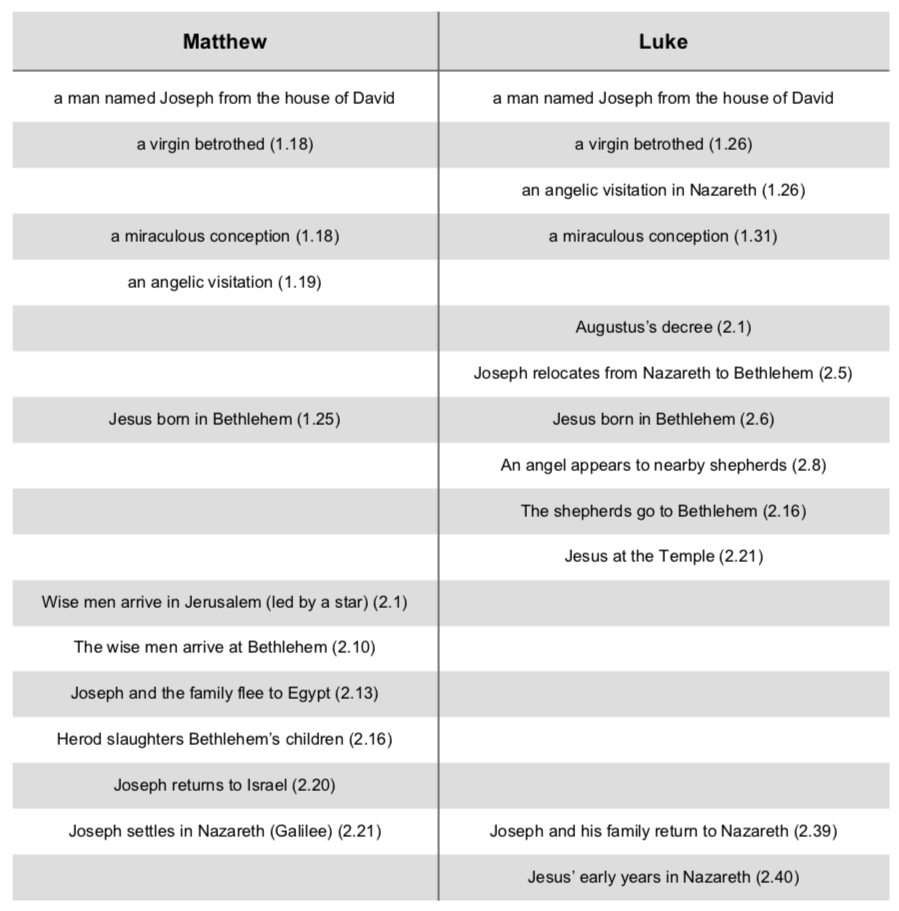
Matthew and Luke'southward narratives thus frame Jesus' early on years against quite different backdrops, which has led many commentators to question the historicity of Matthew and Luke's narratives. If Luke was a competent historian, wouldn't he have been aware of the massacre of Bethlehem's infants? And, if he was aware of it, why didn't he mention it? Why does Luke instead have the family unit caput back to Nazareth, with no mention of Joseph's flight to Egypt? And why, if Luke's narrative is reliable, doesn't Matthew mention Caesar'due south decree and/or the shepherds? Is information technology apparent to recall Matthew was aware of the events recorded in Luke's narrative and yet declined to mention them (and vice-versa in Luke's case)?
That all depends on how and why we think the Gospels were composed. If we recall Matthew's aim was to discover out as much information as he could about Jesus then write information technology all downwardly in a gospel, Matthew's failure to mention sure events does indeed seem problematic (and besides in Luke'southward instance). Very few people, nonetheless, think that's what the gospel-writers did, and for skilful reason. Consider, for instance, Matthew and Luke'southward genealogies. Matthew and Luke were familiar with the OT. Matthew therefore had names available to him which he chose non to include in his genealogy, and Luke had a whole bequeathed line (from Shealtiel to David) available to him which he chose not to include in his genealogy (compare ane Chron iii). More than radically, consider the Gospel of John. Do we think John was unaware of the things he didn't mention in his gospel (e.g., Jesus' temptations, parables, exorcisms, transfiguration, and institution of the Lord'south supper)?
Like all authors, Matthew and Luke wrote with specific purposes in mind. Each human being wanted to tell Jesus' story in his own fashion—to highlight detail themes of Jesus' ministry, to emphasise particular parallels between Jesus' ministry and OT history, and so on. And if nosotros pay attention to how they did so, information technology will help us make sense of their choice of fabric.
Matthew
Then, what are the specific purposes of Matthew and Luke's birth narratives? We'll start with Matthew's. Its distinctives tin be summarised every bit follows.
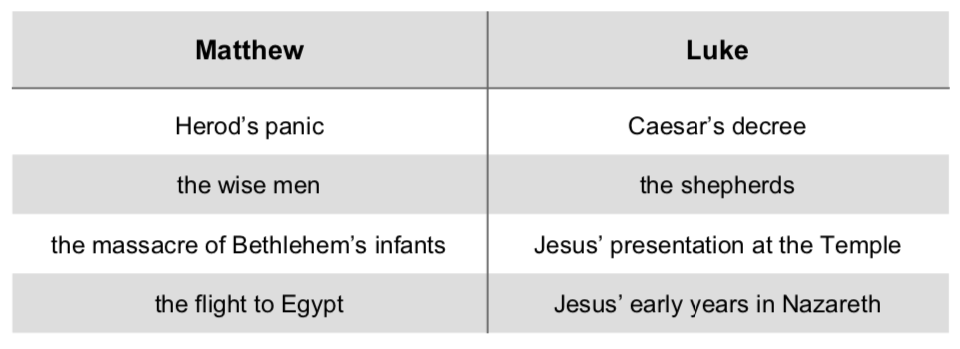
Spelt out more fully: while Luke tells us near Caesar and the census, Matthew tells u.s.a. nearly Herod and the massacre of the infants. While Luke tells us about the shepherds, Matthew tells us about the (star-struck) wise men and their gifts. And, while Luke has Jesus at the Temple and/or Nazareth, Matthew has Jesus' family flee to Egypt.
Now, why has Matthew chosen to tell us about these events in item (rather than those described past Luke)? What's their common theme/connexion? The answer, I advise, is that they're all distinctly exodus-shaped events, which portray Jesus' birth as a sign of an exodus to come up.
Consider some of the relevant parallels. Both stories open with Israel ruled by a foreign overlord (in ane instance an Egyptian, in the other an Edomite). Both revolve around the birth of a child who's destined to deliver his people. In both cases, the overlord in question views the child as a threat (cp. Exod. 1.9–ten). Both stories accept the overlord massacre Israel'south infants in an effort to secure his position. In both stories, God's deliverer flees to a foreign land, where he holes out until his enemies accept passed away (cp. Matt. two.20 w. Exod. 4.19). In both stories, God outwits (ἐμπαίζω) his enemies (cp. Matt. 2.16 w. Exod. 10.2). And, in both stories, God'due south people are made rich past the Gentiles (cp. Egypt'southward wealth w. the wise men'south gifts).
These parallels are no coincidence. Indeed, in Matt. 2.15, Matthew explains the significance of Joseph's sojourn in Egypt past the commendation of Hosea 11.ane: 'Out of Arab republic of egypt I called my son'. Simply as God began a redemptive piece of work in Moses' day when he called State of israel forth from Egypt, so in Joseph's day God will again telephone call his Son along from Egypt and brainstorm an even greater redemptive work.
Matthew'southward allusions to the exodus, however, aren't but a vague anticipation of redemption. They outline a deliberately inverted exodus story. Everything is back to front. The murderous king isn't an Egyptian Pharaoh, but a 'rex of the Jews'. The state in which God's son is imperilled isn't Egypt, just Israel. And the country where the son is accepted isn't Israel, only Arab republic of egypt. Why? Because Jesus' exodus won't just exist a rerun of the original; it will exist a different kind of exodus. The line of segmentation betwixt God's people and God's enemies won't be drawn on the basis of nationality (Israel vs. Egypt: Matt. 8.eleven–12, x.34–39), but on the basis of obedience (12.46–50). And, on the night of the Passover to come, God'due south firstborn Son won't escape death.
The relevance of Matthew'south genealogy
That Matthew's allusions to the exodus are intentional is confirmed by their echoes in Matthew'due south genealogy. Consider, for a start, the notion of a foreign ruler who massacres a host of infants in Israel. Matthew'south genealogy likewise draws our attention to such a ruler, which it does past ways of a conspicuous lacuna in its rex listing.
Suppose I tell you lot I spent last Christmas with my mum, my brothers, and my sisters. While my statement is ostensibly nigh my mum, brothers, and sisters, it draws nearly attention (somewhat paradoxically) to my dad, since it makes you wonder why I haven't mentioned him.
Matthew'due south genealogy works in a similar style. After Jehoram-aka-Joram, the next male monarch mentioned in Matthew's genealogy is Jehoram's great-bang-up-grandson (Azariah-aka-Uzziah). Matthew thus fails to mention three Judahite kings: Ahaziah, Joash, and Amaziah.
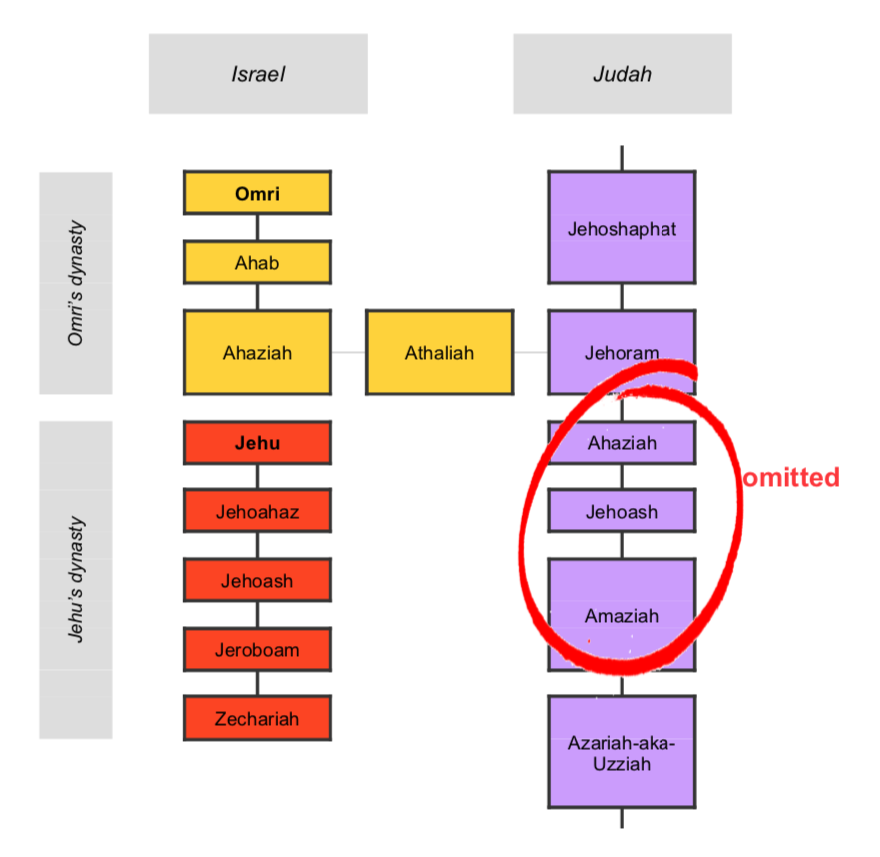
Why does Matthew omit these 3 kings? Part of the answer, I suggest, is to depict our attention to a notable sequence of events which transpired in their days. The accession of Ahaziah was a notable event in and of itself, since Ahaziah was the son of Jehoram and Athaliah, and Athaliah was a daughter of the recently-cursed Ahab (ii Kgs. 8.xvi–18, 25–26). Ahaziah thus represented an unwelcome injection of foreign blood (and behaviour) into David'due south line (cp. 2 Chr. 21.thirteen west. the refs. to Ahab's influence in 22.1–6). And, a year later, an even more notable event took place: Ahaziah died without any sons old enough to succeed him, at which signal Athaliah sought to slay all the potential heirs to the throne and claim it for herself.
Mercifully, all the same, Ahaziah'southward sister managed to spare Ahaziah'south youngest son, Joash, and hide him away (protected by a Gentile guard) until he was sometime enough to reign (cp. 2 Chr. 22–23).
Consider, then, the situation. Nosotros have a foreign ruler in charge of Israel (i.due east., an illegitimate 'rex of the Jews'), a newborn kid who'southward a threat to the ruler's say-so, an attempt to extinguish the 'line of hope', and a member of royal family unit who'south subconscious the child away in a foreign environment. Ring any bells? Information technology should do. It'south another exodus outcome.

Matthew'south male monarch list thus fulfils at least ii important functions. First, it underscores the unity of theme of Matthew'due south narrative. And, second, it underscores the threat presented past Jesus. Jesus is a legitimate heir to the throne of David, built-in in the right place at the right fourth dimension (Matt. two.iii–half dozen), which is why Herod has to eliminate him.
The riches of the Gentiles
A final exodus-like feature of Matthew'due south genealogy can be identified in its allusions to the riches of the Gentiles. Its fourteen-fold periodicity highlights 4 individuals—Abraham, David, Jechoniah, and Jesus—all of whom receive considerable assist and riches from Gentile rulers/nations. Abraham emerges from Egypt not merely unscathed, but enriched past the land's silverish and gold (Gen. 12.10–13.2). David finds (temporary) refuge among the Philistines and is given silvery and gold by Gentile kings (2 Sam. 8.10) (as is his son, Solomon). Jechoniah is shown special favour by the king of Babylon (2 Kgs. 25.27–xxx), as is his son (Zerubbabel), who emerges from Babylon with silver and gold (Ezra 1–2). And, as we've seen, Jesus himself is preserved in a Gentile land and fabricated rich by gifts from foreign lands (compare Exod. 3.22, 11.2, 12.35).
Reflections on Matthew's narrative
In sum, then, Matthew's birth narrative is a conscientious and sophisticated limerick, tied together by a clear unity of theme. Truthful, that doesn't make Matthew's narrative historical, but it does assistance to explain Matthew's selection of material. In the view of many commentators, Matthew and Luke's birth narratives can't both be historically accurate considering Matthew shows no awareness of Luke's census or Joseph's journeying to Bethlehem. How, then, do such commentators call up Matthew'southward narrative should have been written? Well, suppose nosotros rewrite information technology like this:
And then all the generations from Abraham to David were fourteen generations, and from David to the deportation to Babylon 14 generations, and from the deportation to Babylon to the Christ fourteen generations.
Now, the birth of Jesus Christ took place in this way: when his mother Mary had been betrothed to Joseph, before they came together she was found to be with child from the Holy Spirit. And, at near that time, a decree went out from Caesar Augustus that all the globe should be registered, which was the starting time registration when Quirinius was governor of Syrian arab republic. And all went to be registered, each to his own town…
Matthew's narrative is now more consequent with Luke's, right? By the same token, however, it's far less lucid. As we've seen, Matthew'southward genealogy is crafted in such a way as to anticipate Herod'south hostility, and Matthew's commendation of Hosea explicitly frames Herod and Jesus' encounter in low-cal of the exodus. Caesar'southward involvement in the affair is, therefore, irrelevant to Matthew. Caesar didn't occupy the throne of David, nor did he see Jesus as a threat, nor did his decree cause Jesus to abscond to a foreign land. (Indeed, unlike Herod'due south, Caesar'southward decree is conducive to the fulfilment of God'due south purposes.) Consequently, a description of Caesar'southward interest in Jesus' nascence would only dilute and misfile Matthew's narrative. And, as nosotros'll now see, the same is true of Luke'due south (mutatis mutandis).
Luke: The Temple rather than the palace
Matthew and Luke's birth narratives portray Jesus in quite unlike ways. For Matthew, Jesus is a Davidic king, who presents a threat to Israel'south rulers from the moment of his nascence. For Luke, however, Jesus is human being of more humble origins. Jesus is no threat to Caesar (equally yet) and is more than closely associated with the Temple and priesthood than with the throne.

Spelt out more fully:
- Whereas Matthew's Gospel opens with an announcement of Jesus' status equally the long-awaited son of David (ane.1), Luke's opens with a story nigh the struggles of a little-known priestly couple and their duties at the Temple.
- Whereas Matthew's genealogy is headed up by two of the best known figures in Jewish history (Abraham and David) (1.i), Luke's begins in obscurity and works its way upwards to David and Abraham—a direction of travel elsewhere associated with priestly genealogies (cp. 1 Chr. 6.31–48 w. its context).
- Whereas Matthew'southward narrative begins in Bethlehem, Luke'southward begins in the Judean loma-country and later on relocates to Nazareth—a boondocks of little significance in OT history (John 1.46).
- Whereas Matthew's Messiah is born male monarch of the Jews (Matt. 2.2), Luke's begins his ministry building at the age of xxx (equally all priests do).
- Whereas Matthew's birth narrative culminates in the proclamation 'The kingdom of heaven is at hand!' (Matt. 3.ane–2), Luke's culminates in a clarification of Jesus' worship at the Temple (and submission to his parents).
- And, whereas Matthew has Jesus offered 'the kingdoms of the world' at the decision of his temptations, Luke has Jesus brought to the Temple, which is where his Gospel ultimately winds up.
Matthew and Luke thus present Jesus in different ways, though they do and so for similar reasons. Just as the distinctives of Matthew's narrative are intended to frame it confronting a detail OT backdrop (the exodus), so besides are those of Luke's narrative.
Consider the picture Luke paints for united states of america. We take a priestly couple who are unable to take children, a misunderstood woman whose prayer is finally answered, the nascence of a child, a woman who responds in songs of joy, a couple who become up to the house of God each year to worship, and a immature boy left at the Temple, where he astounds his seniors with his wisdom, all prepare against the backdrop of the tenure of two ungodly priests (Annas and Caiaphas) (iii.ii).
Why has Luke chosen to draw these states of affairs in particular? Are they tied together past a common theme? They are indeed. They're a recapitulation of a previous nativity narrative in the Biblical narrative, namely Samuel'due south (1 Sam. 1–2). For Luke, Jesus' nascency doesn't betoken the arrival of a Moses-similar leader, just of a Samuel-like servant—a male child who may not be an immediate threat to men similar Herod, only who will ultimately turn the world upside downward by means of his life and doctrine.
Like Samuel, Jesus will be left at the Temple. From a tender age, his words will astound the wise, and he will grow in favour with God and man. Nevertheless, as fourth dimension goes on, Jesus' words will become more than contentious (4.22–thirty). Although they will convert the hearts of some in Israel, they will harden the hearts of others (virtually notably Jerusalem's authorities), until, in the cease, they spell out the Temple's judgment. 'Non one stone will be left on peak of another! Jerusalem will fall, the heavens will exist shaken, and the Son of Homo volition come up in power and great glory!' (Luke 21). Like a depth charge, Jesus' initial arrival in State of israel volition seem inconsequential, yet it will ultimately bring Jerusalem to its knees.
Luke: Poverty rather than riches
Equally of import to notation is Luke's association of Jesus with the poor. While Matthew has Joseph reside in a firm, Luke has him lodge in a guestroom. While Matthew has Jesus visited by wise men, Luke has him visited by (mere) shepherds. And, while Matthew has Jesus given gold and precious spices, Luke has him taken to the Temple along with a poor human's sacrifice (cp. Lev. 12.eight).
These details are significant. Every bit far equally Luke is concerned, the Gospel is fundamentally for the poor and downtrodden (3.5–6, four.18, 7.22, 14.11, etc.). Jesus has come to inaugurate a Jubilee—a 'year of favour', a fourth dimension when those who have lost their inheritance are given new hope (4.18–19)—, which is precisely why Luke mentions Caesar's Jubilee-like decree, with each Israelite returned to his hometown.
Luke'south rationale
As nosotros've noted, many commentators are unsatisfied with Luke's narrative. They await it to show a greater sensation of the events described in Matthew'due south. Suppose, then, we try to include the flight to Egypt in Luke's narrative (just as we previously tried to include the demography in Matthew's). As it stands, the text of Luke ii.39 reads as follows: 'When Mary and Joseph had done what was required past the Law of the Lord, they returned to Galilee, to Nazareth'. Suppose we effort to contain the flight to Arab republic of egypt in this style:
When Mary and Joseph had done what was required past the Law of the Lord, they went to Egypt for a number of years and later on returned to Galilee, to Nazareth…
Luke's narrative now shows an awareness of its counterpart in Matthew. By the same token, nevertheless, it's a less lucid composition. It as well makes us wonder why Mary and Joseph went to Arab republic of egypt, which (by Brownish et al.'due south logic) requires Luke to tell us virtually the massacre in Bethlehem (also as the wise men'south visit, since the massacre otherwise makes piddling sense). Nonetheless, as nosotros've seen, Luke's intention isn't to innovate Jesus every bit a Moses-similar deliverer born into royalty, but as a humble Samuel-like servant, who grows up in obscurity. Consequently, Luke isn't interested in Herod'due south activities. Luke is interested in the lower profile aspects of Jesus' infancy—in the nearby shepherds rather than the shepherd-male monarch of Micah five.2, in the Temple rather than the palace, and in Nazareth rather than Bethlehem.
Last reflections
Matthew and Luke's decisions most what not to include in their birth narratives are oft seen as a bespeak against their credibility. (If Matthew knew near Luke's demography, he'd accept mentioned information technology; and if Luke knew nearly Matthew's massacre, he'd have mentioned information technology; and so on.) Every bit nosotros've seen, still, Matthew and Luke'southward decisions can't be assessed so simplistically. Matthew and Luke don't ever tell us everything they know, and their omissions serve a purpose.
For Matthew, Jesus is a new Moses, who goes toe to toe with the world's Pharaoh-like Herods, while, for Luke, Jesus is a more subversive and Samuel-like effigy—a human whose ministry lifts up the poor and downtrodden and brings downward a corrupt regime. Consequently, Matthew has good reason to mention Herod, the wise men, and the flight to Arab republic of egypt and non to mention the decree, the shepherds, and Jesus' visits to the Temple, while Luke has good reason to practice the opposite. Contra Brown et al., then, Matthew may have known almost Caesar's decree (etc.) and yet not mentioned it, while Luke may accept known about Herod'south massacre (etc.) and even so not mentioned it.
Where, then, practice our considerations leave usa? If we want to engage with Matthew and Luke in a fruitful manner, nosotros need to engage with them on their own terms rather than on the basis of what we call up they would (or should) accept said (had they known nigh it). Matthew and Luke describe unlike aspects of Jesus' nativity since they portray Jesus as the culmination of different strands of biblical history, and a careful consideration of their narratives enables us to appreciate both the sophistication with which they do so too every bit the remarkable graphic symbol of the Saviour they draw.
(Previously posted in April.)
 James Bejon is a junior researcher at Tyndale House—an international evangelical research community based in Cambridge (U.k.), focused on biblical languages, biblical manuscripts, and the aboriginal earth.
If you enjoyed this, exercise share information technology on social media (Facebook or Twitter) using the buttons on the left. Follow me on Twitter @psephizo. Similar my page on Facebook.
Much of my work is done on a freelance basis. If you have valued this postal service, you can make a single or repeat donation through PayPal:
Comments policy: Good comments that appoint with the content of the mail, and share in respectful debate, can add real value. Seek outset to understand, then to be understood. Brand the virtually charitable construal of the views of others and seek to learn from their perspectives. Don't view debate as a conflict to win; address the statement rather than tackling the person.
Source: https://www.psephizo.com/biblical-studies/why-do-matthew-and-luke-offer-different-birth-narratives/

Post a Comment for "Why do Matthew and Luke offer different birth narratives?"